The Peptide Family Tree
275 molecules across 10 mechanistic families, drawn as lineages of structural and pharmacological inheritance.
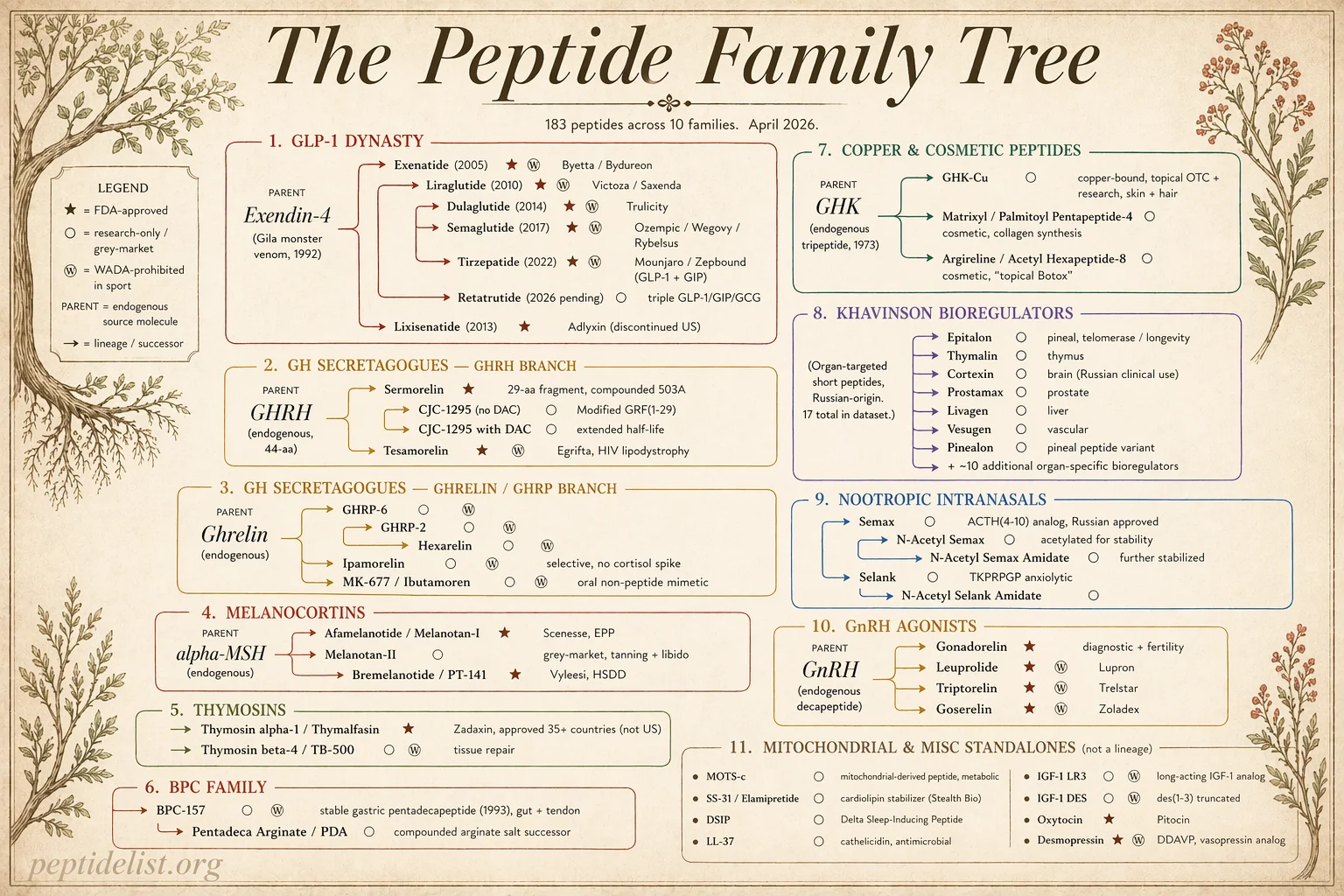
How to read this chart
Each family runs left-to-right: the endogenous parent (or earliest anchor) sits on the left, with structural descendants and pharmacological successors branching out rightward. A solid arrow marks a direct structural derivative or fragment; a dotted arrow marks a next-generation analog that inherits the mechanism but re-engineers the backbone. Some peptides (mitochondrial, antimicrobial, standalone hormones) don't cleanly belong to a lineage and are shown as an island of discrete nodes at the bottom.
Free to embed. Please link back.
This infographic is released under a Creative Commons BY 4.0 license — you can republish, adapt, and share it on your blog, newsletter, or social feed. The only condition is attribution with a link back to this page so readers can find the latest version.
Paste this HTML into your blog, Substack, or site. The infographic will link back to the source.
Most peptide charts you'll find online are alphabetical lists or marketing grids. This one is a genealogy. We grouped every peptide on Peptide List into 10 families defined by shared mechanism — which receptor they hit, which fragment of which native hormone they were carved from, which earlier compound they're a next-generation successor to. A final section collects notable standalones that don't fit a lineage. Each family tells the story of how a single endogenous molecule branched into the peptides people actually use today.
GLP-1 Dynasty
The incretin-agonist lineage that reshaped metabolic medicine. Every generation extended the half-life, added receptor targets, or deepened the weight-loss signal — from a twice-daily injection derived from Gila monster venom to a weekly triple agonist.
Read the full GLP-1 Dynasty pillar page →
- Exendin-4 (Gila monster venom, 1992)— endogenous source molecule
- SSemaglutide— 2017 · Ozempic / Wegovy
- STirzepatide— 2022 · GLP-1 / GIP dual agonist
- ADulaglutide— 2014 · weekly
- ALiraglutide— 2010 · daily
- ARetatrutide— 2026 · triple GLP-1 / GIP / GCG
- BExenatide— 2005 · first GLP-1 agonist
- CLixisenatide— 2013 · short-acting
GH Secretagogues — GHRH Branch
Analogs of growth hormone–releasing hormone (GHRH). Each entry is a structural trim or extension of the native 44-amino-acid hormone, designed to raise endogenous GH pulses without bypassing the pituitary's own feedback loops.
Read the full GH Secretagogues — GHRH Branch pillar page →
- GHRH (endogenous)— 44-aa hypothalamic hormone
- ASermorelin— first 29 aa of GHRH
- ATesamorelin— FDA-approved for HIV lipodystrophy
- BCJC-1295 (no DAC)— Modified GRF(1-29)
- BCJC-1295 with DAC— DAC extends half-life to ~8 days
GH Secretagogues — Ghrelin Branch
The parallel GH-secretagogue lineage that works through the ghrelin receptor rather than the GHRH receptor. Often stacked with a GHRH analog for a synergistic pulse.
Read the full GH Secretagogues — Ghrelin Branch pillar page →
Melanocortins
Analogs of α-MSH, the endogenous melanocortin that drives pigmentation, appetite, and sexual arousal. Early research chased a sunless tan; the breakout clinical wins were in photoprotection and libido.
Thymosins
Peptides isolated from thymic tissue in the 1970s. The α-family modulates immunity; the β-family drives actin-based tissue repair.
BPC Family
Fragments of body-protection compound, a stable gastric pentadecapeptide first isolated in 1993. The arginate salt form was developed to improve stability for compounded formulations.
Copper & Cosmetic Peptides
Topical short peptides that migrated from wound-healing research into cosmeceuticals. GHK (1973) is the endogenous tripeptide that started the category.
Khavinson Bioregulators
Short organ-targeted peptides developed by Vladimir Khavinson at the St. Petersburg Institute of Bioregulation and Gerontology. Each is named for the organ it was isolated from (or developed to target).
Read the full Khavinson Bioregulators pillar page →
- CThymalin— thymus
- DBronchogen— bronchial
- DCardiogen— cardiac tissue
- DCartalax— cartilage
- DChonluten— respiratory mucosa
- DCortagen— cortex
- DEpitalon— pineal · telomerase / longevity
- DLivagen— liver
- DN-Acetyl Epitalon Amidate— stabilized Epitalon
- DPancragen— pancreas
- DPinealon— pineal · neuropeptide form
- DProstamax— prostate
- DTestagen— testicular
- DThymagen— thymus variant
- DVesugen— vascular
- DVilon— immune
- FOvagen— hepatic / ovarian
Nootropic Intranasals
Short Russian-origin neuropeptides designed for intranasal delivery to cross the blood-brain barrier. Semax is an ACTH(4-10) analog; Selank is derived from tuftsin.
GnRH Agonists
Decapeptide analogs of gonadotropin-releasing hormone. Paradoxically, continuous dosing suppresses the HPG axis — which made them workhorse drugs for prostate cancer, endometriosis, and precocious puberty.
Mitochondrial & Standalone Peptides
Notable peptides that don't share a clean lineage with the families above — each sits in its own mechanistic island.